


 GMarcoKinesiology
They didn't just feel better.They got back to doing what they love.
Stories from people who were tired of working around pain and wanted to get back to training, running, lifting, and living with confidence.
135 felt impossible. Now 205 for 3.
His interview below
Where he was.
Three years of back pain. Three cortisone injections, and all of them failed within 24 hours.
Physical therapy, and still waking up locked.
He couldn't walk his dog. He was afraid to sneeze.
What I saw.
His scan looked healthy the whole time.
An injury at work had changed what his hips could do. From what we saw in the assessment, his back had been picking up the slack ever since.
What we did.
We stopped chasing the pain and rebuilt what his body could tolerate.
135 on the bar felt impossible when we started. Now it's 205 for 3.
He's not all the way back yet. But he's back to doing things he thought he'd lost, including a whole vacation without thinking about his back.
"I was definitely a 10 out of 10 for feeling that liability. My numbers have dropped to like a 2."Eric
11 years of back pain. Gone in 12 weeks. He never stopped training.
12 weeks · His testimonial below


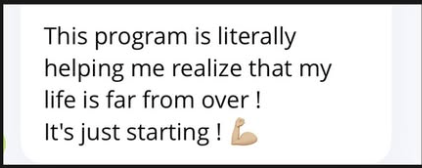
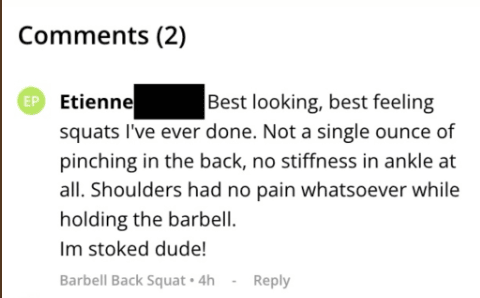
Where he was when we started.
Old broken leg. Ankle sprain. Disc degeneration on top of that.
Eleven years in, he couldn't sit through dinner without his back seizing up.
He'd seen a string of practitioners. Physio, chiro, the usual. Most of them sent him home with the same handout: stretch this, foam roll that, here's a band, see you next week.
It helped for about a week. Every single time.
What I saw that they didn't.
His injury history was important, but it didn't tell us everything about what he could tolerate in training.
So we looked at how he moved, how he loaded, and what needed to change.
What we saw: he lived in extension all day. Pelvis tipped forward, ribs flared, his back doing work other muscles weren't.
The rehab exercises he'd been handed never asked his body to do anything different. That's my read on why nothing held.
Another stretch was never going to fix it. We had to teach his body a new default.
What we did. He kept lifting the whole time.
Positional work to bring his ribs and pelvis back into a stack. Reset the breathing. Rebuilt full-body mobility as actual capacity, not as a warmup.
Then we loaded it, which is the part most rehab skips. Squats, bench, deadlifts, all three, with variations he could own at his current level and progress week to week.
By week 12 he was back to training he hadn't touched in years. No 40-minute warmup. No bracing for the flare-up that used to be coming.
Daily life back too. Renovating, going out, sleeping through the night.
"I forgot what it felt like to not think about my back."Étienne
Sound like your back? That's exactly who I built this for.
Apply for REBUILD 1:1 →Pain 4 to 0. A tweak that used to cost days now costs one.
About 8 weeks · Her interview below
Where she was.
She couldn't sit in a car for more than twenty minutes before her back started throbbing. Things shoved behind her low back, repositioning the whole way.
The bigger cost was the randomness. A tweak from something ordinary would take her out for days.
When something flared, her instinct was to back off. Less weight, less range.
What I saw.
A pattern she'd lived in so long she couldn't feel it. Weight parked in her heels, hamstrings and glutes clenched around the clock, pelvis pushed forward.
Nothing had been loaded yet when the first change showed up. Day 10, in her words: "I am feeling my hamstrings shut off for the first time in my life."
What we did.
We shut off what was always on, turned on what wasn't, and then loaded it.
One month in: "my body just feels more and more like a UNIT everyday."
Week 7, she tweaked her back doing something ordinary. What would normally cost her several days cost her one.
By week 11, asked what she was still avoiding because of her back: "Nope." Chest pressing 70 lb, barbell deadlifts back in. Pain went 4, 3, 2, 1, 0.
"You finally taught my body how to move and function and accept load properly. You have taught my body how to work as a body."Rachel
7 years stuck on the same bench number. Past all of it in 3.5 months.
3.5 months · His testimonial below
In French with English subtitles.
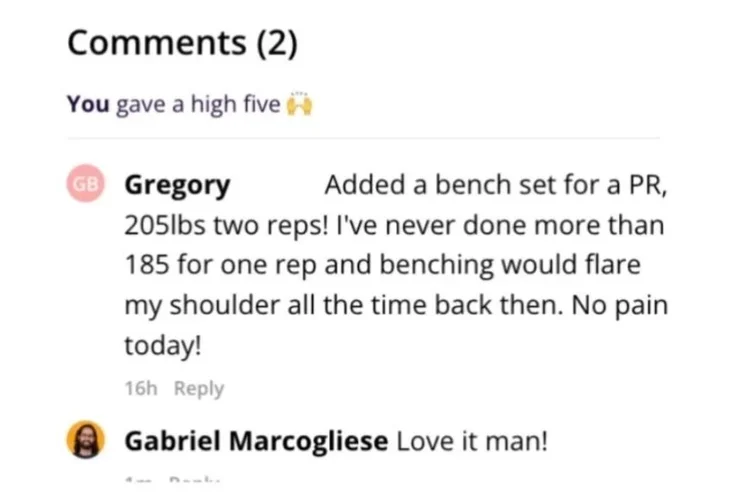
The cycle he was in.
Greg's lifted his whole adult life. Best numbers at 30, then seven years trying to get back to them.
Train hard, hit a wall, push through, get hurt, three months off, start over. Shoulder one cycle, wrist the next. Every time he got close, something gave.
He was running internet programs. Two naps a day. Pre-workout to train, sometimes pre-workout just to get through a work shift.
He figured he was getting older. He was getting under-recovered.
What was actually going on.
The plateaus weren't an effort problem. He was working harder than most of my clients.
We looked at the demands of his training, how he was progressing his loads, and where his preparation wasn't matching those demands. He was always one rep away from the weakest link going.
He was doing what felt good in the gym instead of what his body actually needed. After seven years, the gap between those two things stops being small.
What we changed.
First thing was AMRAP and endurance blocks, the kind of work he'd never have programmed for himself. He hated it for two weeks. Then his work capacity caught up and his recovery flipped.
Then progressive overload that respected what his body could actually take right now. Built around him, not a cookie-cutter PDF.
By month 3.5 he was hitting numbers he hadn't seen since 30. No naps. No pre-workout. More energy after training than before it.
"It's a difficult journey, but it brings so much."Greg
Strong but stuck and breaking down on repeat? That's a pattern we can work on.
Apply for REBUILD 1:1 →Surgery on October 6th. Cleared to run by November 20th.
6 weeks post-op · Her testimonial below
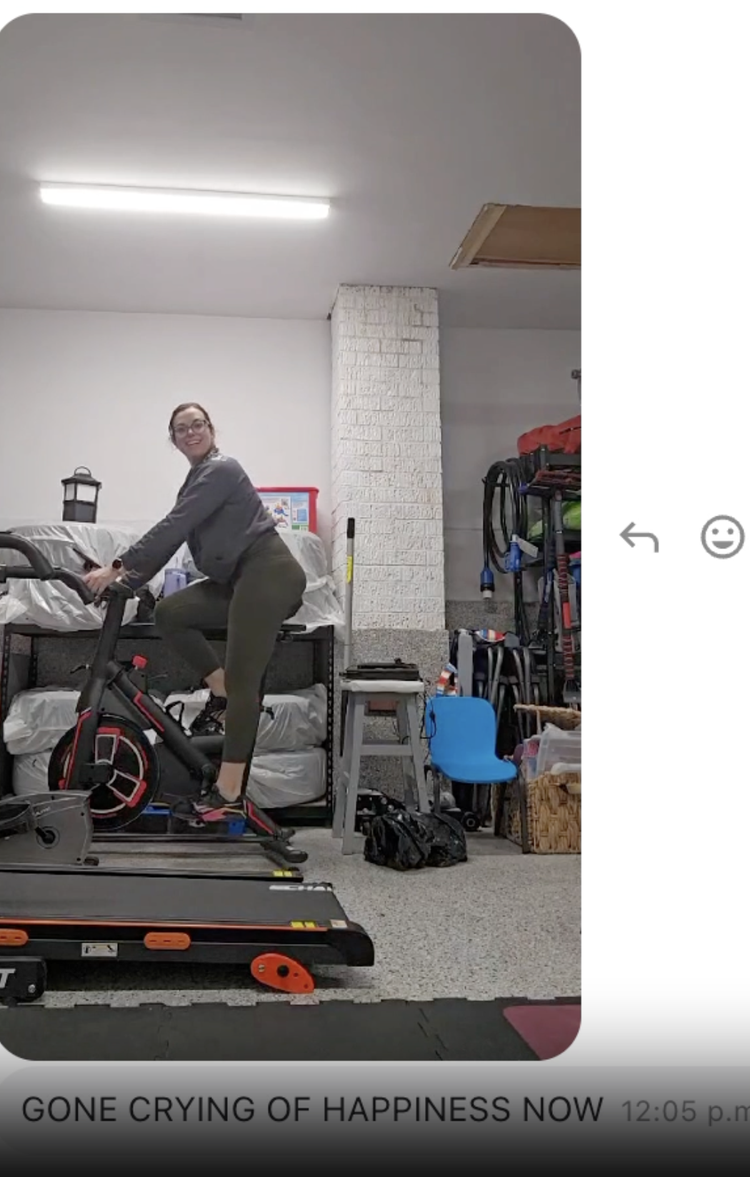
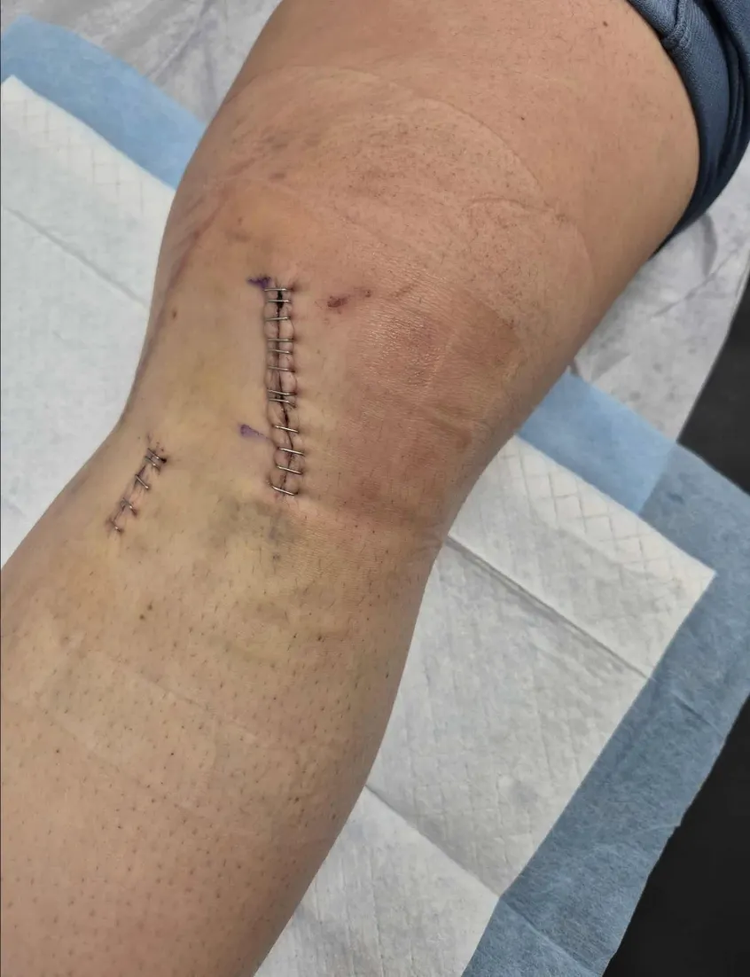
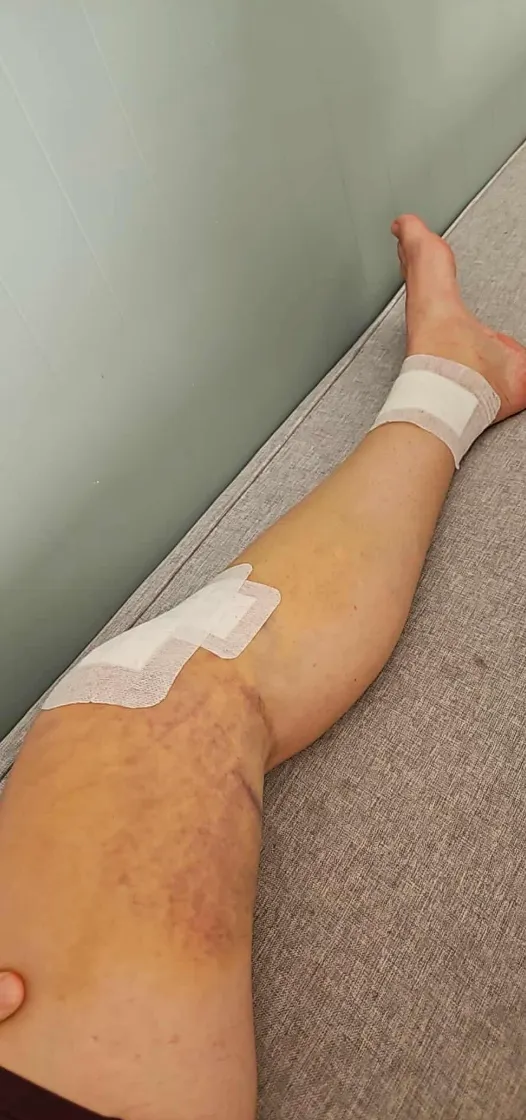
Where she was.
Stress fracture. CrossFit gone. Marathon training gone.
Surgery booked for October 6th, and the only plan after that was rest and hope. Her medical team gave her a recovery timeline measured in months.
She told me she was scared this might be it, that the running version of her wasn't coming back.
What I told her.
We reviewed her training history and the running volume she'd been carrying before the fracture. The plan had to rebuild those demands progressively, while respecting her recovery and her medical team's guidance.
Rest and hope on its own, even with the surgery, wasn't a return-to-sport plan. It was a return-to-walking plan, and I wasn't going to let her settle for that.
She needed bone healing and tissue capacity and running mechanics. All three, sequenced properly, not stacked at the end and hoped for.
The phased plan.
Post-op weeks 1 to 2: foundational movement, pain-free positions, isometric loading at the fracture site inside healing tolerances.
Weeks 3 to 4: progressive load through the chain, biking in as the first real cardio.
Weeks 5 to 6: running mechanics drills, then a structured run-walk progression timed to her bone-healing markers, not to a calendar.
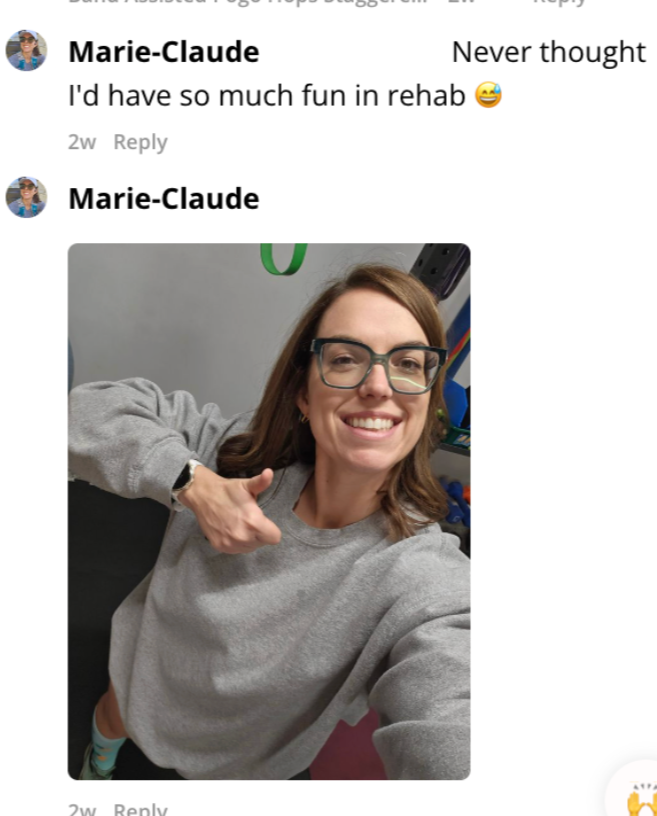
November 20th she texted me: her medical team had cleared her to run. From there we started the run-walk progression. I was on paternity leave. She was too excited to wait for our next call.
From "this might be it" to running again in six weeks. CrossFit and the next marathon, back on the calendar.Marie-Claude
Couldn't walk her dogs. 4 months out of the gym. Back under the bar.
Reveal → Reset → Rebuild · Her assessment below
Where she was.
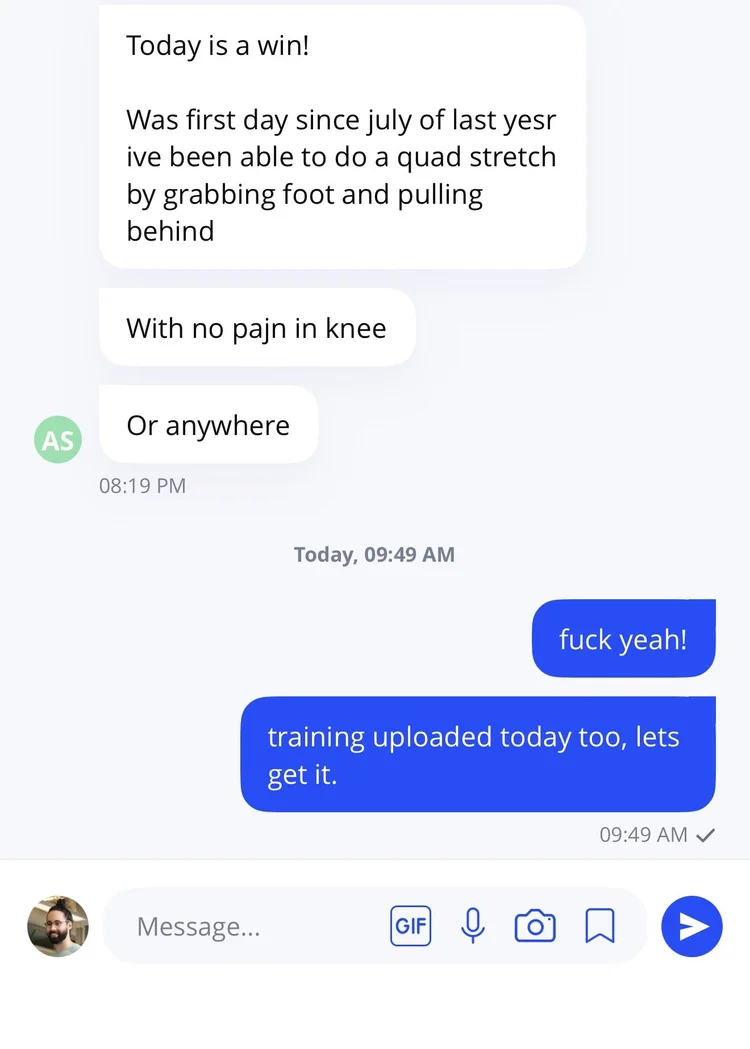
Amy's back got so bad she couldn't walk her dogs. One of her favorite things, gone.
She didn't train for four months, and this is someone who loves to train.
She'd seen multiple people. Each one moved the needle a little, none of them actually solved it. Four months of treatment and she was no further ahead.
Reveal. The Ground-Up Assessment™.
Your pain is the last thing to show up, not the first. By the time the back seizes mid-deadlift, the body's been compensating for weeks, sometimes months or years.
Treat only where it hurts and you're walking in at the end of the story. In my experience, that's often why it keeps coming back.
So before I look at the painful spot at all, I read the whole story. The foot, since it's the first thing touching the ground. Hip rotation. Where the body actually sits in space. And the training itself, because a lot of the time it's too much, too fast, too soon on a system that wasn't ready.
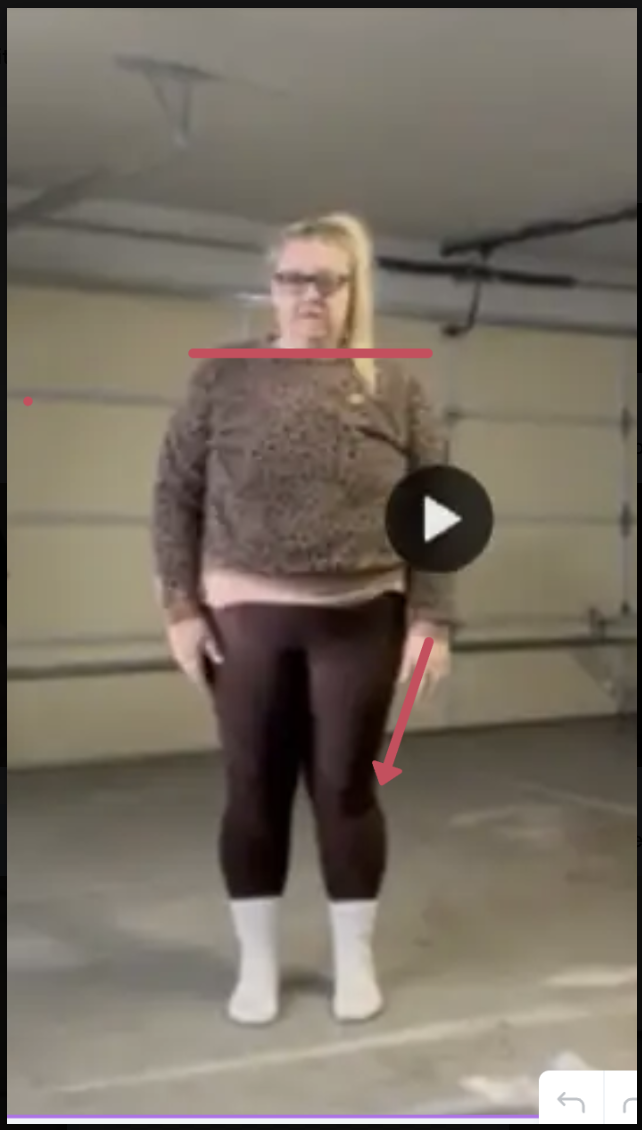
In Amy's assessment photos we noticed movement and strength differences worth addressing. A shoulder dropping. A knee falling in. Her weight shifted to one side.
We used those findings to guide her training progression.
Reset. The roadmap, not the fix.
The assessment was the map, not the cure. I track every new client over time: posture from every side, single-leg stance, toe touch, standing rotation, squat, split squat left versus right.
Then she gets the roadmap, Reveal, Reset, Rebuild, so she knows what we're doing right now, what she gets out of it, and when she moves up. Most people in rehab never get told where they're going. Amy did.
Rebuild.
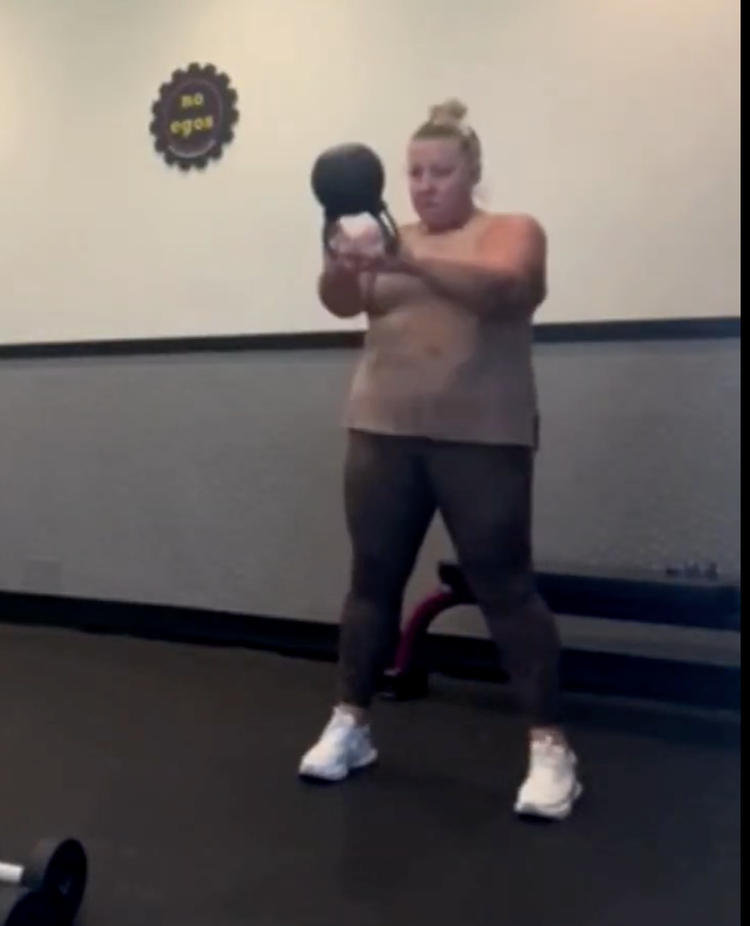
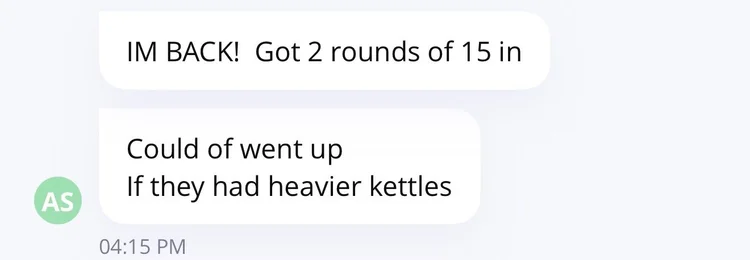
Once the training started changing what we'd found, she sent me a video of herself doing kettlebell swings. Walking the dogs again. Training heavy again.
Four months stuck, then back under the bar.
"I'm back."Amy
If your pain has cost you something you love, that's the conversation to have.
Apply for REBUILD 1:1 →4 months of pain and leg numbness. Now pain-free and lifting heavy again.
Reveal → Reset → Rebuild


Where she was.
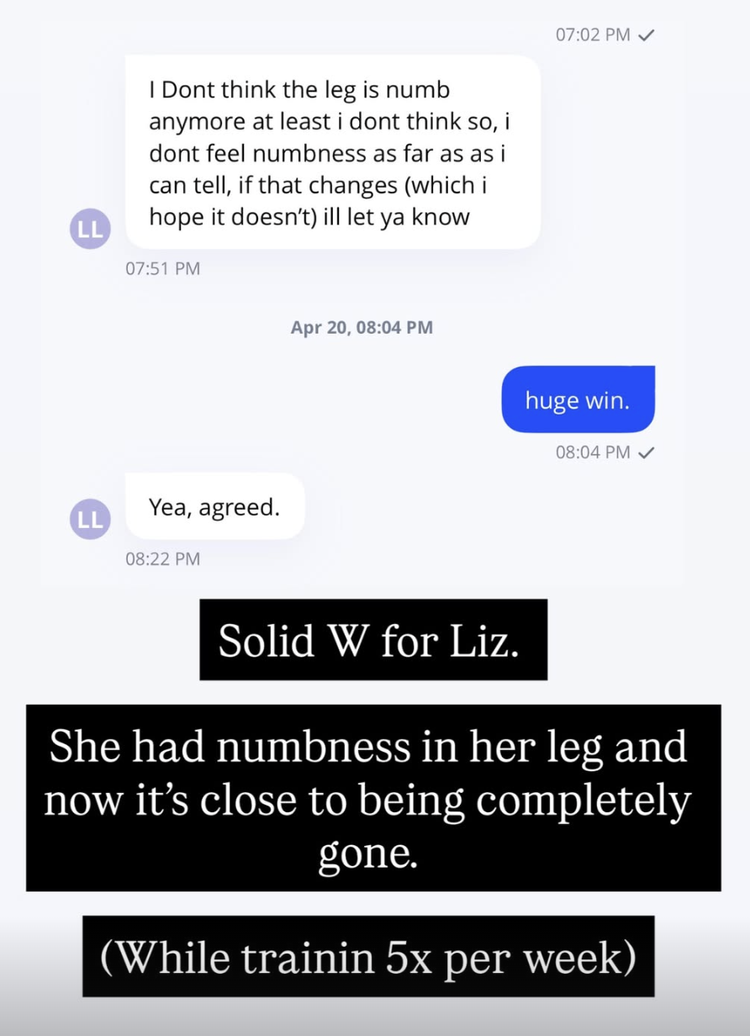
When Liz came to me she was frustrated. Four months of pain. Leg numbness. She could barely bend forward without it bothering her.
She'd already tried chiro and nothing was really shifting.
What got to her most was that nobody understood her actual goal. She didn't want to just be "functional." She wanted to get back in the gym and lift heavy.
Reveal.
In the assessment we saw her loading the right side of her body more than the left, over and over.
Rather than focusing only on the symptoms, we looked at the broader picture: her training demands, the movement options she had, and the capacity that might have been contributing.
When a body has lost its efficient ways to move, it borrows from everywhere else just to keep going. That's usually when symptoms keep coming back no matter what someone tries.
Reset.
First we brought the tension and guarding down so her body could absorb load again and find support from the ground up.
Then a lot of single-side work, alternating patterns, rotational work. The goal was getting hip rotation, pelvic movement and better pressure distribution back, so the right side stopped carrying everything.
Once she stopped guarding against movement, things moved fast. Less numbness. Less hesitation. Then she could bend forward comfortably again.
Rebuild.
We rebuilt her tolerance to two-sided lifting and layered load, volume and intensity back in.
She's pain-free now and back to lifting heavy, the exact thing she came here for and the thing nobody else would even build toward.
From four months of pain and leg numbness to pain-free and lifting heavy again.Liz
8 years of back pain. He just wanted to lift without being afraid.
In progress · His testimonial below
Where he was.
After 8 years of back pain, he just wanted to train without bracing for the next flare-up.
So the problem stopped being pain. It became what happened every time he reached a heavy barbell.
Pain wasn't what was holding him back. The fear of setting it off again was.
What I saw.
You can get stronger and still not trust your body.
Often it's the body working around a problem instead of sharing load through the system.
What we did.
We stopped chasing pain. We rebuilt the movement his body was missing, then loaded it back toward the CrossFit he loves.
He's still in the work. That's the honest version.
"I wasn't really hopeful of any improvement. Now I'm feeling hopeful. Excited for more."Axel
If you still hesitate every time you load, the work isn't finished. Fear is the last symptom most rehab forgets to treat.
Apply for REBUILD 1:1 →Two years of sciatica. She thought I'd tell her to stop deadlifting.
About 4 months · Her interview below
Where she was.
Two years of sciatic pain down her left side. Sitting hurt. Driving hurt. Getting out of bed in the morning took a minute.
Physio gave her clamshells and core work. Her chiropractor told her she'd reached the limit of what she could help with. Tens of thousands of dollars in, and very little relief.
Some days she'd feel great under the bar. Then on the last rep something would go, and she was back in the hole.
The deadlifts went. The squats went. When the family sat down to watch a show, her kids would drag in a special chair and put the heating pad on it for her.
In her words: "It's like being told to sit out on your life."
What I saw.
Her biggest fear wasn't the pain. It was the next practitioner telling her no more deadlifts, no more squats, no more of the fun stuff.
She's a coach herself and she loves to push. Effort was never the problem. How she was dealing with gravity was: posture tipped forward, feet not grounding into the floor.
So taking the lifts away was never the plan. Keeping her under the bar was.
What we did.
Structure she'd never give herself. Sets capped at an RPE of 7 or 8. Elevated deadlifts. Sets of 10 instead of one big scary rep.
She found the boring part hard. Her words: "I was surprised that it worked."
During a busy stretch she rushed a workout, racked a 50 lb dumbbell, and felt it go. A real flare. She expected me to ask what she did wrong. We adjusted the plan instead, and she was back training within 48 hours.
Now, about half the time she doesn't think about her back. When it shows up, it sits around a 1 or 2. She steps out of the car without waiting for it to let go.
She's training hard again and working toward competing. She'd be the first to tell you she isn't "fixed." The pain just isn't taking away the things she loves anymore.
"I think pain tells us it'll always be this way. And I would just tell that version of me that it can be different."Lillian
Scared the next person will tell you to stop lifting? That's exactly who I built this for.
Apply for REBUILD 1:1 →Every one of these people did 1:1 coaching. Different history, different body, different effort.
I won't promise you their exact results. What I can tell you is that each of them started the same way: an honest look at what was actually going on, then training built around it.
Want every review, not just the ones I picked?
Every Google review of GMarco Kinesiology, written by clients. I don't get to curate these.
Read the Google reviews →I'm Gabe. Kinesiologist. Same back-pain story as a lot of you.
Kinesiology is the science of human movement. I'm a coach, not a doctor or a physio, and I work alongside your medical team, not instead of it.
When a client is "cleared to run," that clearance comes from their medical team. My job is getting them ready to earn it and to hold it.
Before any of this was a thing I do for clients, I spent years with my own back pain figuring out what rehab kept missing for me.
I work with a small number of people one-on-one at a time, some in person, most remote. The work is the same either way: a full assessment, programming built around your body, and weekly coaching through it.
What "Apply" actually means.
- It's a short form, not a payment. Nothing is charged when you apply.
- I read every one myself. If we're not a fit, I'll tell you straight.
- If we are, I send you a booking link and we walk through what your plan would look like before you commit to anything.
- Coaching is 1:1. A full assessment, a program built around your body, and weekly coaching through it. In person or fully remote, same process.
Reading the wins is one thing. Becoming one is the work.
If you want what they got, it starts the way it started for them. An honest look at what's actually going on.
Apply below and you'll hear back from me, not a funnel.
More wins


REBUILD™ is a training and coaching program. It doesn't replace medical diagnosis or treatment.
© GMarco Kinesiology · Privacy policy